
Overlaying an Asbestos Cement Roof for a commercial unit, Harrogate.
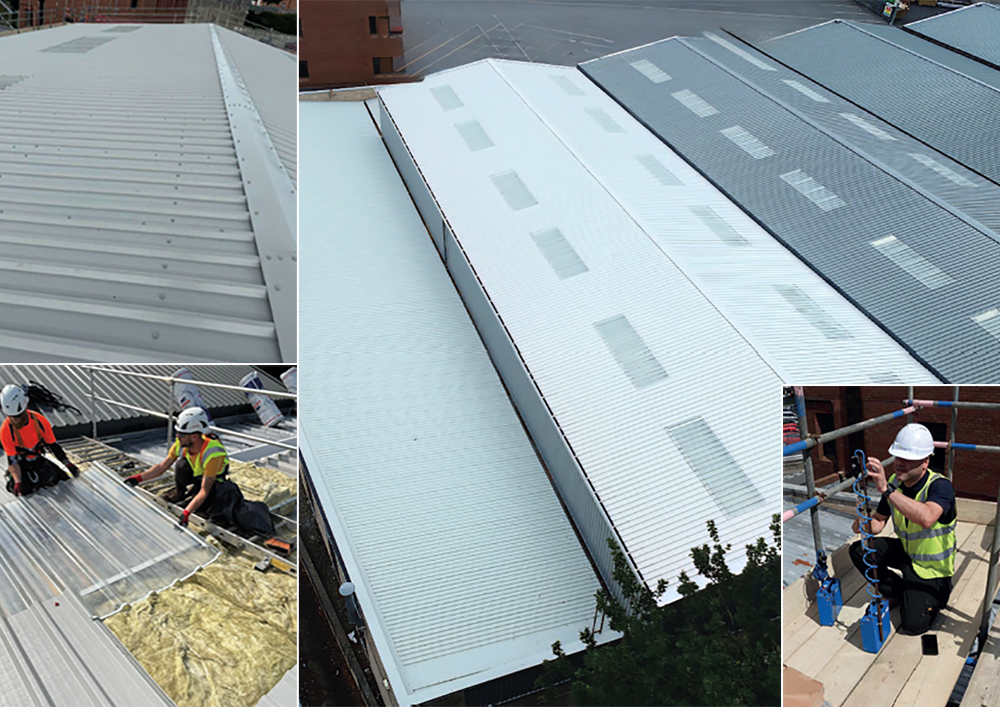
PROJECT OVERVIEW: Roof refurbishment in Harrogate
Building Type: Single-storey warehouse (circa 1970s).
Roof Area: 700 m²
Project Duration: Five weeks.
Principal Contractor: AB Roofing Solutions Ltd.
Roof Build-Up: Existing asbestos cement sheeting, new galvanised steel rail and bracket system fixed through existing sheeting to purlins, AVCL, mineral wool insulation layer, and trapezoidal steel top skin.
Live Environment: Store remained operational throughout construction.
Background
Roof refurbishment in Harrogate. The client required refurbishment of their logistics warehouse roof due to ongoing water ingress, thermal inefficiency, and general deterioration of the existing asbestos cement (AC) corrugated sheets. The key objective was to improve weather resistance and energy efficiency without disturbing the hazardous ACMs (Asbestos-Containing Materials).
A full roof removal and replacement was initially considered but dismissed due to:
• High cost and waste disposal implications
• Disruption to ongoing warehouse operations
• Health and safety risks during asbestos removal
Instead, a non-intrusive over-roofing (overlay) system was proposed and agreed upon.
Key Challenges
Asbestos Management:
All existing roofing sheets contained Chrysotile (white asbestos). Disturbance needed to be avoided.
Working at Height and Fragile Surface:
The roof was fragile and required specialist access and fall protection systems.
Live Site Operations:
The store remained operational throughout the refurbishment, requiring noise and dust control.
Weight Load and Drainage:
Overlay system design needed to consider existing structural load capabilities and to allow gutter access maintenance.
Health and Safety Strategy
Working above a live retail store posed significant health and safety risks, including:
• The risk of falls from height
• Fragility of the existing asbestos cement roof
• Risk of asbestos fibre release
• Risk to operatives, staff, and members of the public from falling tools or materials
• Noise, dust, and disruption to customers and staff
A rigorous Construction Phase Plan was developed under CDM 2015 regulations, with detailed risk assessments and method statements (RAMS). The Principal Contractor and Client worked collaboratively to identify, mitigate, and manage the health and safety risks.
KEY RISK MITIGATION MEASURES
Public Safety Below
• Exclusion zones were created, with high-visibility signage and fencing.
• A crash deck scaffold was erected internally beneath the roof work area to protect staff and customers from falling objects.
• The crash deck was sealed using high-density polythene sheeting to prevent debris and dust ingress.
• The crash deck was erected at night in phases, directly below the roof, allowing the store to remain operational.
• Remote air monitoring equipment was placed between the crash deck and roof sheets.
WORKING AT HEIGHT
• A full edge protection working platform system was installed before work commenced.
• Non-fragile access systems including walk boards and temporary roof platforms were used to avoid loading the fragile roof surface.
• Operatives used fall arrest harnesses and were trained in rescue procedures.
• Material handling was designed to reduce manual handling at height through mechanical hoists and roof loading platforms.
Asbestos Risk Management
• An Asbestos Survey was carried out to confirm the type, condition, and extent of asbestos cement.
• The asbestos cement sheets were left undisturbed; fixings for the rail system were designed to go through the existing sheets into structural purlins below, avoiding any removal of the asbestos.
• All drilling was carried out using pre-approved methods.
• All operatives received asbestos training in compliance with the Control of Asbestos Regulations 2012 (CAR 2012).
• A watching brief and air monitoring were implemented during intrusive works.
Installation Sequence
Fixing Rail System
• Brackets fixed through existing sheets into purlins using approved fixings.
• Dust extraction/elimination in use at all times.
• Fasteners used for the brackets were coated in light grease prior to penetrating the asbestos roof sheet.
• Location of the brackets were coated in a diluted
PVA solution prior to the fasteners being installed to encapsulate any fibres released.
• Rails installed to create sub-structure for new roof.
Insulation Layer
• Air and Vapour Control Layer (AVCL) installed and fully sealed.
• Mineral wool insulation laid tightly butt-jointed under the rails.
Top Skin Installation
• Trapezoidal steel sheeting fixed to rails with self-drilling fixings.
• Eaves and ridge flashings installed to complete the system.
Finishing and QA
• Site cleaned and scaffold removed.
• Final air monitoring and clearance testing.
• QA inspection and sign-off by client (and independent consultant).
Outcomes and Benefits
Operational Continuity:
The store remained open with minimal disruption, maintaining customer footfall and revenue.
Improved Building Performance: Roof U-value reduced to ~0.18 W/m²K.
Extended Roof Life: New system guaranteed for 25 years.
Regulatory Compliance: CDM 2015, HSG33 and CAR 2012.
Lessons Learned
• Early collaboration between Principal Designer, Contractor, and Client was key to balancing operational needs and safety.
• Phased working and clear communication with store staff ensured smooth co-ordination.
• Investment in temporary protection (for example the crash deck) proved essential for public safety and peace of mind.
• Maintaining detailed site logs and air monitoring records provided vital reassurance in managing asbestos risks.
Conclusion
The over-cladding project successfully delivered complex roofing works over fragile asbestos-cement roof sheets in a live commercial environment, thanks to robust planning, clear communication, and rigorous safety management. By adopting an over-roofing strategy, the project mitigated high-risk asbestos removal activities while maintaining full operational continuity for the building occupants.
The case study has highlighted that by taking a comprehensive approach to early-stage design coordination, stakeholder engagement, and methodical sequencing, it’s possible to identify and control critical risks, such as working at height, roof fragility, and asbestos encapsulation—without disrupting day-to-day business activities. Close collaboration ensured alignment among duty holders and timely sharing of essential information.
The project delivered long-term performance benefits, including improved thermal performance, weather resistance, and compliance with regulatory standards, all the while preserving the existing roof system. It avoided landfill waste and reduced environmental impact by retaining the original asbestos-cement sheets in situ.